

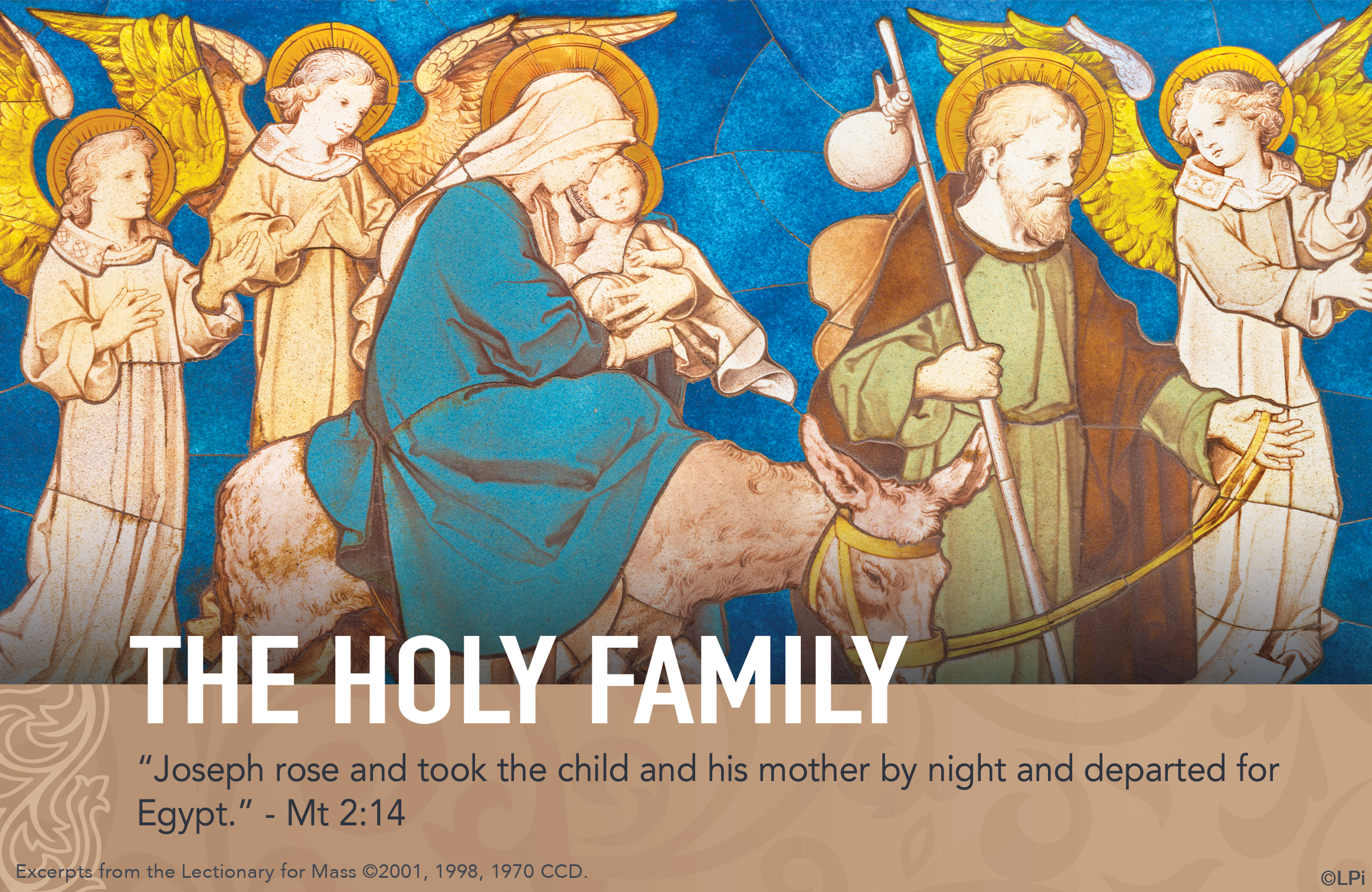
The Holy Family

~ Today is the Feast of the Holy Family of Jesus, Mary, and Joseph, always celebrated on this Sunday between Christmas and New Year, a time when many families are together celebrating the holidays. While it may be tempting to think of the Holy Family as the perfect family, they certainly had their own trials and tribulations. Coming during Christmastime, this feast reminds us that the Holy Family had to flee Bethlehem after the birth of Jesus because of King Herod’s jealousy. Some commentators have sought to draw parallels between the plight of the Holy Family and the plight of modern-day migrants and refugees, especially those subject to inhumane treatment in our nation. How accurate are these comparisons? Were Jesus, Mary and Joseph what we would consider today “refugees”? Yes.
Allow me to share a reflection from Fr. James Martin, SJ on this topic:
In the second chapter of the Gospel of Matthew, we read the story of the “Flight into Egypt” in which, after the birth of Jesus and the visit from the Magi, an “angel of the Lord” comes to Joseph in a dream and warns him to leave Bethlehem for Egypt. Why? Because King Herod was planning to “seek out the child to destroy him.” Mary and Joseph do leave, along with Jesus, and, according to Matthew, make their way into Egypt. Afterward, King Herod slaughters all the male children in Bethlehem under two years of age. This dramatic episode is part of the Gospel reading for the “Feast of the Holy Innocents,” celebrated on Dec. 28.
So, according to the Gospel of Matthew, what is going on? A family is forced to flee their homeland for fear of persecution. This is the classic modern-day definition of a refugee. In fact, the United Nations High Commissioner for Refugees defines that group of people as follows: A refugee is someone who has been forced to flee his or her country because of persecution, war, or violence. A refugee has a well-founded fear of persecution for reasons of race, religion, nationality, political opinion or membership in a particular social group. The Holy Family, as Matthew recounts the story, was fleeing because of a “well-founded fear of persecution” because of their “membership in a particular social group,” in this case people with young children living in Bethlehem. I am not sure how you could get any clearer than that.
Did Joseph and Mary apply for official refugee status? Of course not. Those kinds of regulations were most likely not in effect. There may not have even been any borders at the time. But Egypt, which came under Roman control in 30 B.C., was outside the jurisdiction of Herod. Egypt had been the traditional place of refuge for Jews in biblical times. Thus, we see a family fleeing to a foreign country out of fear of persecution.
Even the language used in Matthew illuminates their situation. Matthew, writing for a Jewish-Christian audience around AD 85, presents the angel’s command as follows: “Arise, and take the child and his mother, and flee into Egypt….”. The word to focus on is “flee,” from which derives the word “refugee,” the one who flees. Even Matthew’s angel identifies the Holy Family as refugees.
But even if the Holy Family does not fit the contemporary definition of refugees (and they do) and even if the Gospel of Matthew did not use the Greek word for flee (and it does), we should still have compassion and be ready to care for modern-day refugees and migrants.
Why? Because Jesus asks us to. Later in Matthew’s Gospel, Jesus reminds us that any time we “welcome the stranger” we welcome Jesus himself (Mt 25). Refugees and migrants are our brothers and sisters desperately in need of our help. Jesus’ command to care for the stranger is also, for the Christian, a law superseding any laws that would hinder, prevent or outlaw such care and compassion. Surely these refugee and migrant families deserve our protection as much as the Holy Family did.
I am so proud of the wonderful ways our Catholic Church and our parish community advocate for migrant and refugees. Especially in the year to come, let us continue to pray for our migrant brothers and sisters, resist demonizing them, advocate for their protection, and work together to build up the Body of Christ in our midst.